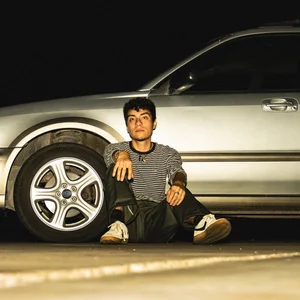
A Conversation w/ MARIS
From early mornings in New York to finding connection through “Chameleon,” MARIS is figuring out how to build a life in music without losing herself in the process.
After singing “Chameleon,” MARIS asks everyone in the room to hug themselves. She checks the back, too. Nobody gets to quietly sit this one out.
The song can leave her feeling exposed. Written during a period when she was exhausted, insecure, and trying to become whatever other people wanted, it’s a difficult place to revisit in front of an audience. The hug gives her somewhere to go afterward. So does the sentence she asks everyone to repeat: “I love you just the way you are.”
It’s something she wishes she could tell the version of herself who wrote it.
MARIS is funny and candid when she talks about her life, often making a joke in the middle of a painful memory. A story about moving across the country includes bad housing, early shifts, and gigs where she couldn’t hear herself sing. A major festival appearance comes with the practical question of how to afford a band. She loves an outfit change, but she’d also like to explain how to pull one off on a budget.
Behind those stories is someone who has spent years trying to make the life she imagined as a kid feel possible.
Growing up in Missoula, Montana, gave her a community she still values. She credits home with teaching her how to work hard and show up for other people. She loves the landscape, loves going back, and lights up talking about old friends appearing at shows in different cities.
It could also feel isolating.
She describes that isolation through her queerness, including the ways she dressed, expressed herself, and understood the world. As a teenager, she shaved her head partly out of frustration with the expectations placed on her appearance. She wanted some control over how people saw her.
Leaving gave her room to find out what else was possible. Her mother’s condition was straightforward: save $5,000 herself before moving to New York. MARIS worked at Target and a pizza place, put money aside, and moved in October 2017, shortly after turning 18.
New York meant an air mattress, a job at a market research facility, and waking up at 4 a.m. to make it to work by six. It also meant encountering more ways of living than she had known growing up. Even the train ride could make her feel that her world was getting bigger.
“I remember being so in love with the grime and the grit of just working, working, working, working,” she says.
Around those shifts, she played shows. She remembers early gigs at Rockwood Music Hall where she could barely hear anything and felt like she was screaming into the microphone. She is not especially generous toward the songs she wrote then, but she values what those years taught her.
There were moments when she wondered about the college experience she hadn’t had. Instead, she was learning to pay rent, get to work, and keep making music when the circumstances were far from ideal.
By March 2020, she was opening for Macy Gray at Brooklyn Bowl. Then the pandemic brought that chapter to an abrupt end. Frightened by what was happening in New York, she returned to Montana.
Back home, she started making music much as she had in high school: recording covers, posting online, and spending hours in GarageBand. Eventually, a conversation about pursuing pop music helped point her toward Los Angeles.
Music had been part of her life long before any of those moves. As a child, she sang to herself while walking around her father’s place. Her sister introduced her to GarageBand on a laptop, giving her somewhere to record the songs already forming in her head.
She also had a habit her family called “dancing about”: putting on headphones, moving around, and imagining an entire performance. The stage, the clothes, the choreography, the audience’s reaction—she could picture all of it.
She still does it. These days, she can put on her own songs.
“I feel like I’m making music that has caught up with my taste a little bit,” she says.
Getting there has involved learning what she does well and finding people who can help with the rest. Lyrics and melodies often arrive quickly. Instrumentation takes more work. She might enter a session with a rough idea and references for a drum sound, a chord progression, or some small detail she loves in another record.
Sometimes she understands the emotional meaning only after the song is finished.
“I’ll listen back to it after the song is done and be like, ‘Oh my God, that’s how I feel.’”
“Chameleon” came out of a much less comfortable period. Working with co-writer and producer Ian Walsh, she found somewhere to put feelings she had been struggling to carry. Her career felt stalled. She was working at a coffee shop and worrying about money. Creative relationships had become draining, with decisions feeling like arguments.
“I will be anything you want me to be,” she recalls feeling. “Just believe in me.”
She describes the embarrassment of changing herself to please people and realizing it hadn’t helped. Singing about it can still feel uncomfortably close to self-pity. But performing the song has changed her relationship with it.
People sing the words back. Some hold their chests and cry. What felt painfully personal turns out to be familiar to others.
“Even though I’m embarrassed about those feelings,” she says, “I’m definitely not the only one who has them.”
That connection has begun to shape how she thinks about the job itself.
For her first festival appearance at Boston Calling, MARIS put together a show with horns, dancers, and a jumpsuit adapted for an onstage outfit change. Working with musicians already based in Boston helped make the performance possible within her budget.
But another performance during that visit stayed with her just as strongly. After reaching out to Boston Music Project, she arranged to sing for a group of children. Having grown up aware of the struggle to fund music education, she wanted to support the people helping young musicians get started.
The experience helped settle a question that can get lost in the pressure of a big show: what was she actually there to do?
“The point is to use my medium to make people smile and make people feel connected,” she says.
Back in Missoula, that idea became personal again. Performing at Pride, she saw people she had known in high school—people whose identities and experiences she hadn’t understood back then—standing in front of her, emotional, while she sang “Chameleon.”
“We sat next to each other,” she remembers thinking, “and we never talked about this.”
Her hometown show didn’t have the full festival setup. It was MARIS, backing tracks, some technical difficulties, and a little improvisation. Still, the people in front of her knew the song. Years after sitting together in a classroom, they finally had something they could say to one another.