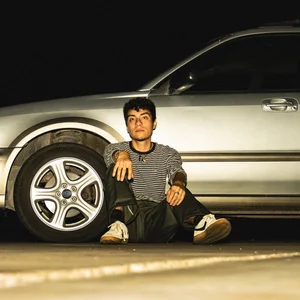
A Conversation w/ Prince of Eden
At Last Exit Live in Phoenix, the artist talks about the bands that shaped him, making music without overthinking it, and heading out on his first tour.
Prince of Eden’s tour van has a TV bungee-corded to the back of the seats. There’s Mario Kart, there’s Smash, and there’s a band of friends running on very little sleep. It’s his first tour, and even with all the work that went into getting here, he seems a little surprised that it’s happening.
“I never really thought I would do this,” he tells HEAR IT! at Phoenix’s Last Exit Live. “Doing it DIY is like a lot of work, but it’s fulfilling.”
Earlier, he played an acoustic show nearby for fans who couldn’t attend the venue’s 21-and-up show. He’s still talking about how much that meant to him. Now he gets to plug in and play with his friends.
The conversation has a few interruptions. He spots other musicians and compliments their set, introduces his brother, and points out his bandmates. He sometimes loses his train of thought while tracing an influence or explaining an idea. Those moments are part of the charm: he’s excited about music, and he has a lot of people to thank for it.
Before there was a tour or a solo project, there was an idea to start a band with his brothers. The name needed to be good. He loved the sound of Kings of Leon and started trying out names with a similar feel. Eventually, the band became a solo endeavor, and Prince of Eden stuck.
“I tried to put some profound meaning behind it,” he says.
Having grown up in the church, he imagined God as the king of Eden and Adam as its prince. Adam, in that interpretation, was someone experiencing everything for the first time. That gave him a way to explain what he wanted to do with his songs.
“I want it to kind of feel like it’s the first time you’re experiencing some of these feelings.”
He’s honest that the name initially appealed to him simply because it sounded cool. But the meaning he found in it makes sense alongside the way he talks about his favorite artists. He remembers when their music began to affect him, and how certain songs only clicked once he was old enough to understand the feelings behind them.
Growing up, he listened to Katy Perry, Drake, Rihanna, Kanye West, and the Black Eyed Peas. His dad loved Motown and taught him basic piano chords. His mom listened to worship music and, occasionally, Fleetwood Mac.
Around eighth grade, he found Walk the Moon, Young the Giant, and Two Door Cinema Club. Indie dance opened up something new for him. Then came The 1975.
“The 1975 took over my life,” he says. “Like, completely.”
At first, he wasn’t ready for them. Both The 1975 and The Neighbourhood sounded a little too grimy and distorted for his taste. A year or two later, he found himself connecting with the same music he had struggled to get into.
“I started feeling those things,” he says.
He had always liked writing. Now he wanted to write songs of his own.
His early attempts at production came through the SoundCloud era: simple beats, 808s, hi-hats, a synth, maybe a friend rapping or a hook he could sing. He describes learning to produce almost like putting together a puzzle. Each part had a place, and gradually a track would emerge.
It took more confidence to make the kind of music he really wanted to make. His love of The Killers and The 1975 stayed with him, but he also became drawn to The Lumineers and the directness of performers like Zach Bryan and Tyler Childers.
“There’s something so raw about somebody who can just kill it on an acoustic guitar and vocals,” he says.
Ask him where his own music fits, and the description starts to pile up: indie, folk, rock, pop, synth. He seems comfortable letting all of it in. These are the sounds he grew up with, the artists he found later, and the things he’s still learning how to do.
He also gives himself somewhere to put the music that falls outside the main project. Through side projects, he can release demos and experiments without making each one a major event. Sometimes a song is finished enough to share, even if he could keep working on it.
He likes the thought of someone stumbling across one of those releases and only later discovering his involvement. He’s had that experience with artists he loves: finding a song, getting attached to it, then checking the credits and recognizing a name.
“It keeps music alive for you, too,” he says of those projects. “It doesn’t make it such a job anymore.”
That matters when so much of being an independent musician involves getting people’s attention. He talks about the pressure to be funny, interesting, or successful at something else just to get someone to listen. A straightforward announcement that you’ve released a record can disappear with a scroll.
He has clearly spent time thinking about that problem. The side projects give him a break from it. He can make something, release it, and enjoy the possibility that somebody will find it.
For now, though, there’s a tour to play. He’s looking forward to Oklahoma City, where he’ll see friends and share a bill with people he makes music with. He’s expecting to be exhausted by the time he gets home. Coffee is helping.
When asked what people should expect from a show, he keeps the answer simple.
“Come to chill, like hang out and just have a good time,” he says. “If you know it, sing along.”